
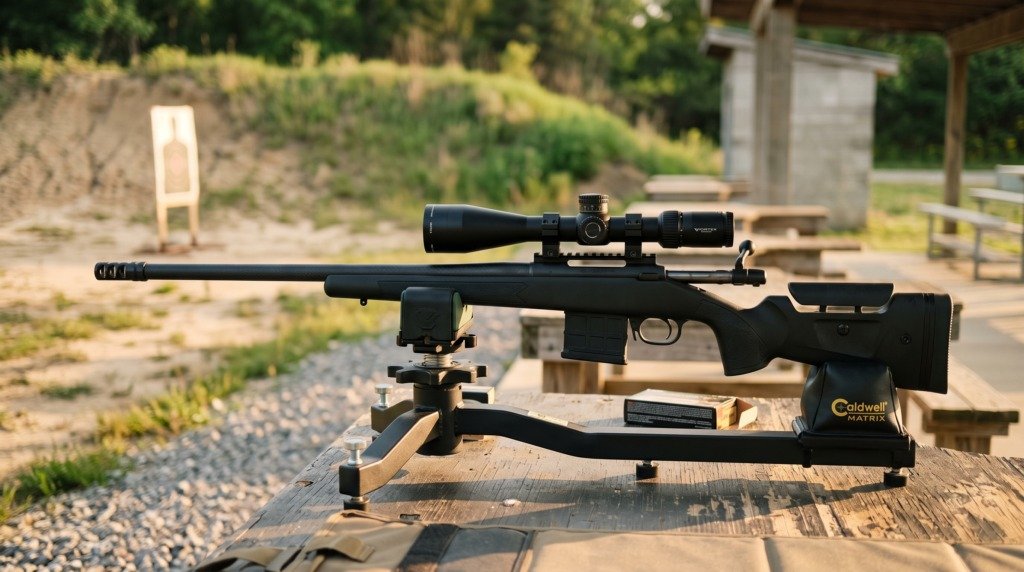
Every season we get some version of the same question at the counter: “I just mounted a new scope — now what?” It’s a fair question. A scope that’s dialed in wrong doesn’t just cost you a miss, it costs you confidence, and that follows you the rest of the day. So here’s the actual process we use, not the shortcut version.
Start on Paper, Not in the Field
Bore-sight first if your setup allows it, then get to paper at 25 yards before you ever think about stretching out to 100. Twenty-five yards is close enough that you’ll actually hit the paper even if you’re off, and that’s the whole point — you need a group to adjust from, not a guess.
The Three-Shot Group Rule
One shot tells you nothing. Fire three, from a rested position, and let the group — not any single shot — tell you where you’re really hitting. If your three rounds are scattered more than they’re grouped, that’s a you-and-the-rest problem before it’s a scope problem. Get stable first, then adjust.
Adjust in the Right Direction (Every Time)
This sounds obvious until you’re standing there second-guessing yourself. Move the turret toward where you want the bullet to go, not away from where it hit. Most scopes label this clearly, but check your specific model’s instructions rather than assuming — we’ve seen more than one zero ruined by an assumption here.
Confirm at Distance
Once you’re dialed in at 25, move out to your actual working distance — 100 yards for most rifles, closer for a lot of hunting handguns, farther if that’s your setup. Re-confirm with another three-shot group. Don’t skip this step because the 25-yard group looked good. Scopes and barrels don’t always scale perfectly, and the only way to know is to check.
Why We Still Double-Check Ours
We mount and zero optics on our own guns every season, and we still walk through this same process every time — no skipping steps, no “it was fine last year.” Mounts shift, ammo lots vary, and a scope that was perfect in October can be off by spring. Five minutes of paper time saves you a ruined morning in the field.
That’s really the whole philosophy: nothing here is complicated, it’s just worth doing right and doing every time. If you’re setting up a new scope this season, take the twenty minutes. Future you will be glad you did.