
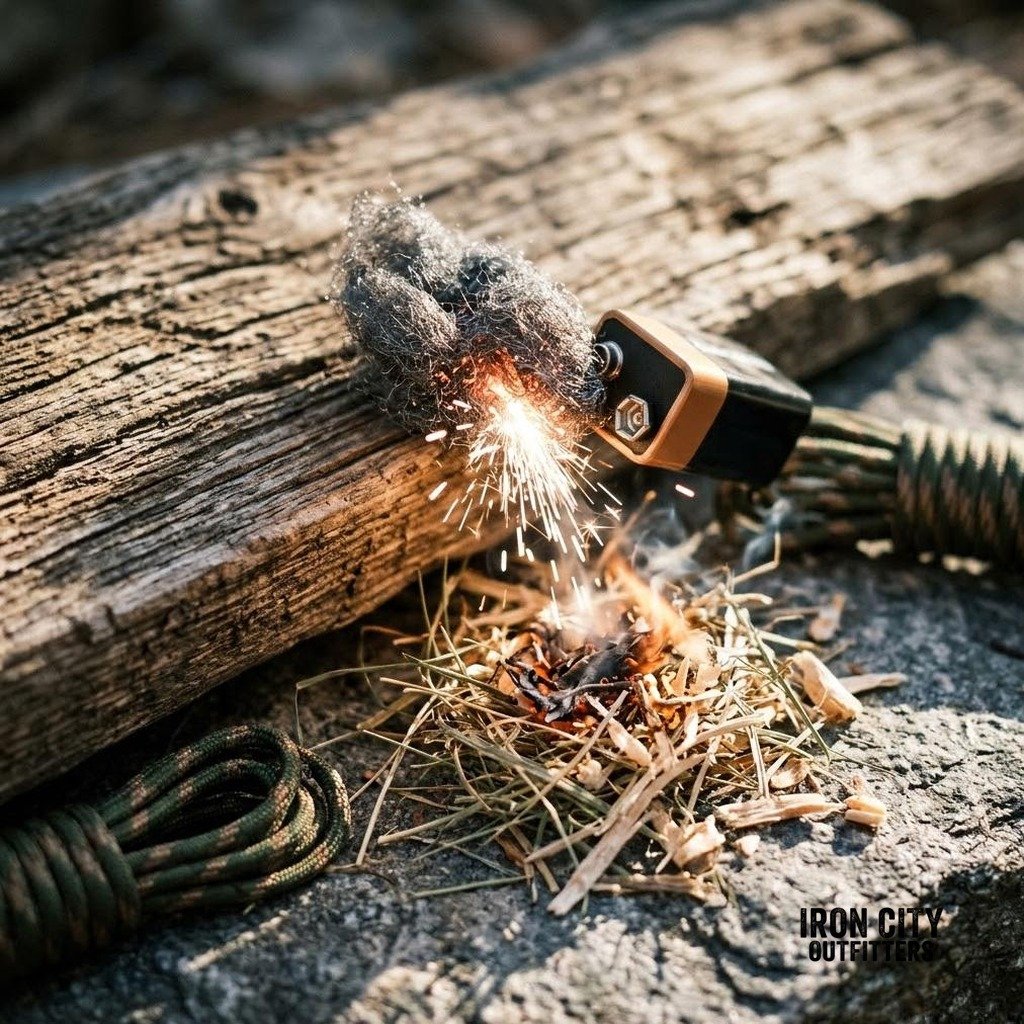
A collapsed tarp, a soaked pack, and a lighter that will not spark — the temperature is dropping fast, and the only power source within reach is a 9-volt battery pulled from a dead headlamp an hour ago and tossed aside as useless. It is not useless. It is one of the fastest, most reliable ignition sources available in a survival kit, and the “dead” label only means the battery lacks the sustained voltage to run a motor — not the amperage required to start a fire.
Standard alkaline 9-volt batteries carry two exposed terminals on a single face, spaced roughly a centimeter apart. Fine steel wool — grade 0000, the finest commercial cut — is composed of thousands of hair-thin ferrous filaments with an enormous surface area relative to mass. When both terminals contact the same strand simultaneously, current is forced through a conductor far too thin to carry it safely. Electrical resistance converts that current into heat almost instantly (Joule heating), and because the filaments are already-oxidizing steel with a huge surface-to-volume ratio, the heat pushes the metal past its ignition point. The strand does not melt — it burns, in a visible shower of white-orange sparks, at temperatures exceeding 1,000°C. That combustion is enough to set dry tinder ablaze within seconds, even in wind or a light drizzle that would snuff a match outright.
This works because steel wool ignition is a self-sustaining exothermic reaction, not a fragile spark. Once the fibers catch, combustion continues independent of the battery, which can be pulled away immediately. The technique also works precisely because a battery has been declared “dead” by a motor-driven device: headlamps and radios require sustained voltage under continuous load, while this reaction only requires a single momentary current spike through a hair-thin conductor.
[Click Here to Copy This Survival Protocol & Field Checklist]
Two failure points end most attempts at this technique: wool that is too coarse (grades 0, 00, and 000 carry too much mass per filament to reach ignition temperature) and tinder that is too damp or too densely packed to catch a spark shower rather than smother it. Preparation before contact, not improvisation after, determines whether this reaction produces a survivable fire or a wasted battery.
Full Field Protocol & Checklist
- Stage dry tinder first. Birch bark, dry grass, fine wood shavings, or a cotton ball smeared with petroleum jelly. Build a loose bird’s-nest shape to maximize airflow before ignition begins.
- Prepare the steel wool. Tease a fist-sized clump of grade 0000 steel wool into a loose, fluffy mass. Flatten it slightly to increase filament-to-filament contact across its surface.
- Confirm battery polarity. Both terminals must sit on the same face of the battery for single-strand contact to complete a circuit.
- Make contact. Touch both terminals to the steel wool simultaneously, brushing lightly across the fibers rather than pressing hard into the mass.
- Watch for ignition. A bright orange glow will race along the fibers within one to two seconds. Pull the battery away the instant ignition starts to prevent battery drain and terminal damage.
- Build the ember. Blow gently and steadily on the glowing wool to intensify the heat, then transfer the burning mass into the prepared tinder nest.
- Coax open flame. Cup the nest loosely and blow in short, controlled bursts until flame breaks through the tinder.
- Feed progressively. Add pencil-width kindling once flame is established, followed by finger-width fuel, then standard fuel wood.
Field Checklist:
- Grade 0000 steel wool — carry a minimum of one full pad, stored dry
- Spare or “dead” 9-volt battery (or any battery with both terminals on one face)
- Pre-gathered dry tinder, stored in a waterproof pouch
- Eyes averted or shielded during ignition — sparks travel outward from the contact point
- A non-flammable surface (stone, dirt, metal) beneath the ignition point
Assisted by AI; content may contain inaccuracies.