
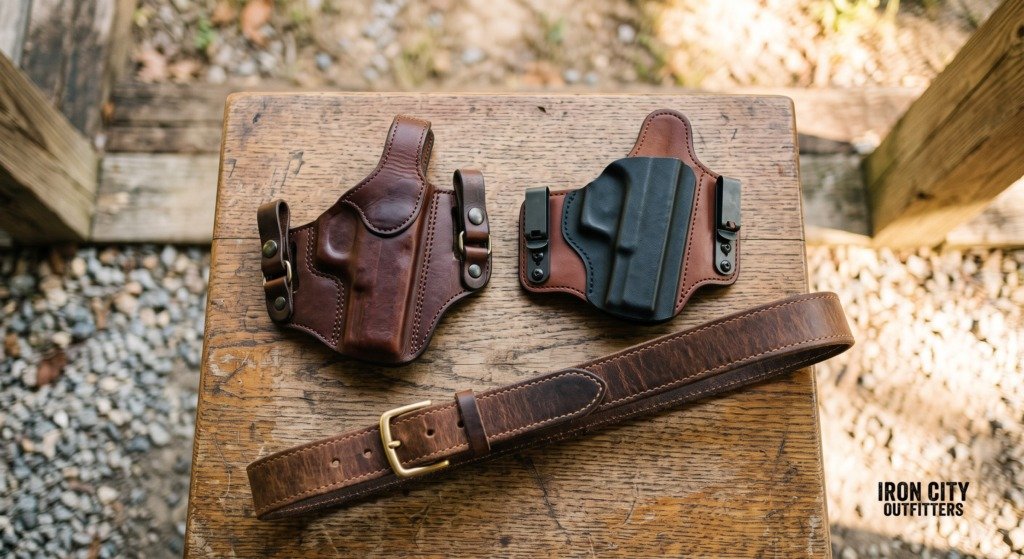
This is usually the second question after “what gun should I carry,” and it matters just as much. The right gun in the wrong holster ends up in a drawer instead of on your belt. Here’s the actual difference between the two main styles, and how to think about which one fits how you live.
OWB (Outside the Waistband)
An OWB holster rides outside your pants, usually held on with belt loops or paddle attachments. It’s more comfortable for all-day wear, easier to draw from consistently since the gun sits in the same position every time, and it’s the standard choice for open carry, range use, and duty work where concealment isn’t the priority.
The tradeoff is obvious — it prints more, and it’s genuinely hard to conceal under anything but a jacket or an untucked heavier shirt. If concealment is the whole point of why you’re carrying, OWB alone usually isn’t going to get you there in most climates.
IWB (Inside the Waistband)
An IWB holster tucks inside your pants, between your body and your waistband, which is what makes it so much easier to conceal — a properly fitted IWB rig under a regular t-shirt is genuinely hard to spot. This is the standard for daily concealed carry for a reason.
The tradeoff is comfort and it takes real adjustment. You’re adding a gun and a holster inside your pants, which means sizing your belt and waistband up slightly is common, and a full day of IWB carry takes some getting used to if you’ve never done it. The draw is also a little less consistent than OWB until you’ve put in the reps.
So Which One Do You Actually Need
If you’re carrying openly, running a range day, or on duty where concealment isn’t the goal, OWB is the more comfortable, more consistent choice — no reason to fight concealment problems you don’t need to solve.
If the entire point is concealed daily carry, IWB is where almost everyone lands eventually, even if it takes a few weeks of adjustment to get there. A lot of people actually own both — OWB for the range, IWB for daily carry — rather than trying to make one holster do both jobs.
The One Thing We Tell Everyone
Whichever style you pick, fit matters more than brand. A holster that’s cut specifically for your exact gun model, sits at the right retention level, and covers the trigger guard completely is not optional — that’s a safety requirement, not a preference. If a holster doesn’t fully cover the trigger, it doesn’t belong on your belt, full stop.