
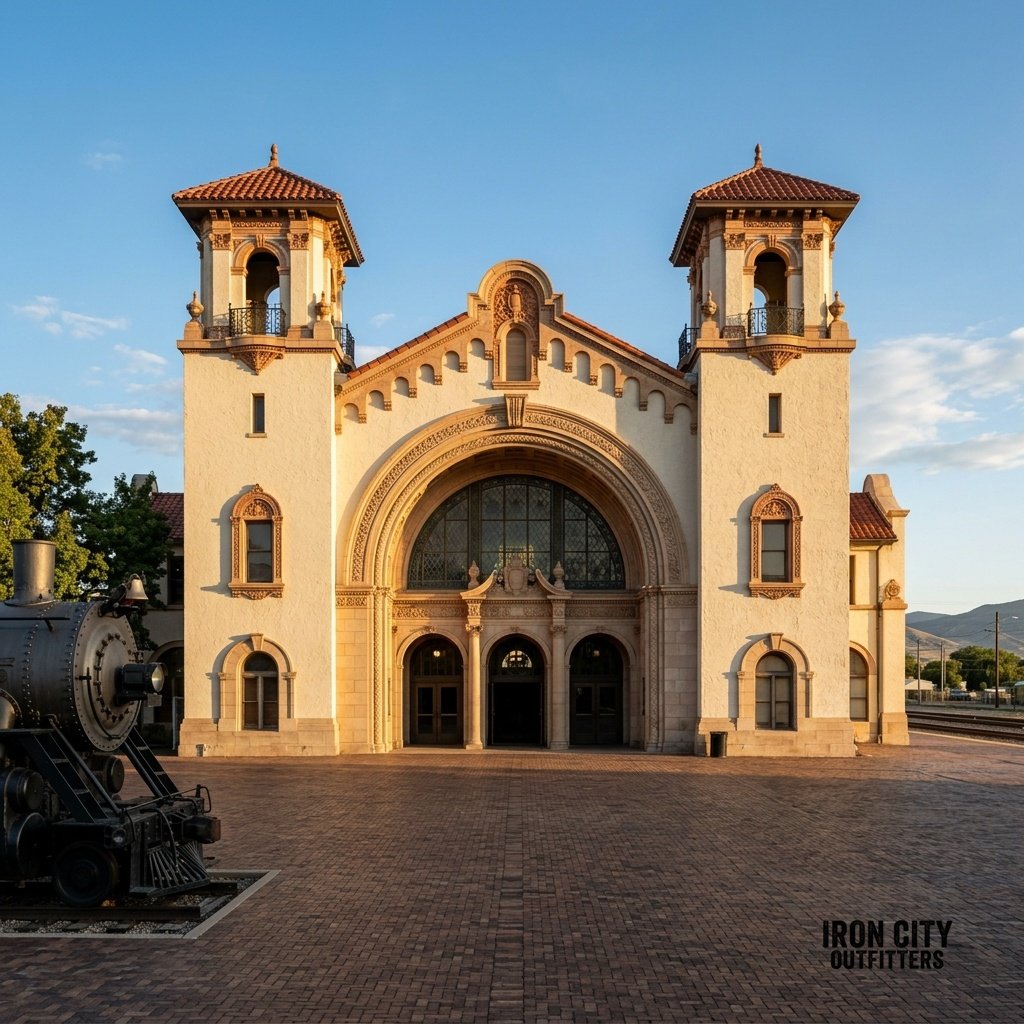
Snowmelt off the Wasatch peaks funnels through Weber Canyon and empties into a valley floor where granite cliffs surrender to grid streets, rail spurs, and the low industrial hum of a city built on transit. Two blocks from that seam between raw range and platted commerce rises a structure engineered to answer both: Ogden’s Union Station, a Spanish Colonial Revival terminal whose limestone facade and red-tile roofline have presided over the junction of the American West since 1924.
The building standing today replaced an 1889 predecessor lost to fire, redesigned by architects John and Donald Parkinson with the same Byzantine-influenced grandeur later applied to Los Angeles City Hall. Twin towers flank a barrel-vaulted entry; inside, the Grand Lobby climbs fifty-six feet to exposed ornamental trusses, its walls carrying murals of the transcontinental railroad’s construction and mosaic-tiled drinking fountains that have outlasted a century of passenger traffic. Following the Golden Spike ceremony at nearby Promontory Summit in 1869, Ogden became the fixed point where the Union Pacific and Central Pacific lines converged, earning the city its enduring title: Crossroads of the West. Through the 1920s, more than sixty passenger trains a day moved through these platforms, and both World Wars routed freight, mail, and troop transport through the same terminal floor.
Amtrak service ended in 1997, but adaptive reuse kept the structure load-bearing within the city’s cultural infrastructure rather than surrendering it to vacancy. The Utah State Railroad Museum now occupies the depot’s east wing, tracing the mechanics and labor of westward rail expansion; the Spencer S. Eccles Rail Center, the John M. Browning Firearms Museum, the Utah Cowboy and Western Heritage Museum, and the Browning-Kimball Classic Car Museum fill the remaining galleries, turning a single terminal into a compressed archive of regional industry. Outside, restored steam locomotives and rail cars sit static on preserved track, their riveted steel a counterpoint to the stucco arches framing them.
Street access and visitor parking sit along Wall Avenue, within view of the Weber River corridor that first justified the junction’s location: Union Station, Ogden, Utah.
Few structures in the Intermountain West compress geology, labor history, and architectural ambition into a single 56-foot lobby ceiling. Ogden’s Union Station remains the clearest evidence that the region’s rugged terrain and its built environment were never separate stories — only different chapters of the same transit.
Assisted by AI; content may contain inaccuracies.