
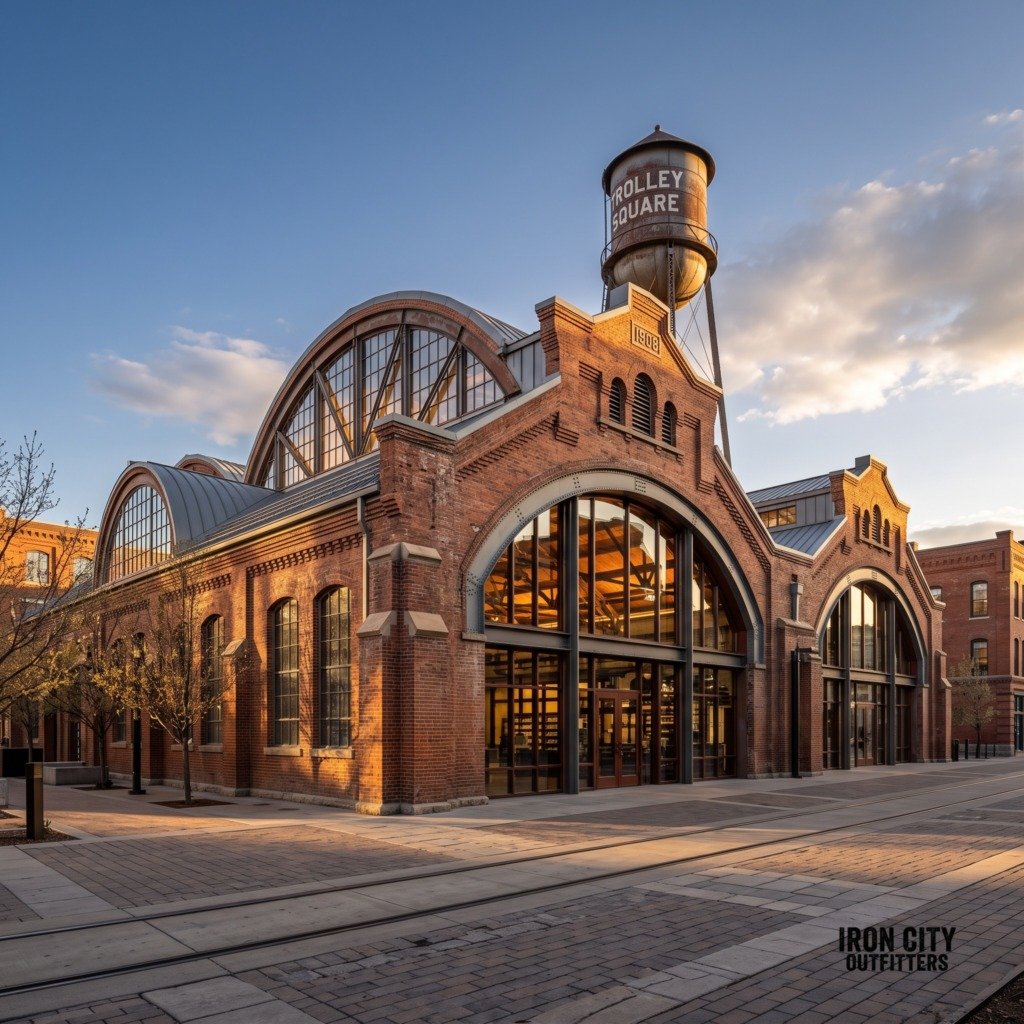
Granite peaks rim the valley in serrated white, indifferent to the grid below — but four blocks east of downtown, a different kind of monument holds its ground at street level, built not from stone thrust upward by tectonic force but from three million bricks laid by hand in 1908. Trolley Square occupies the footprint of the old Salt Lake City railway barns, a cluster of barrel-vaulted sheds engineered to house electric streetcars, and the structure still reads like an artifact of a city that once ran on rails rather than freeway exits.
The barns’ arched clerestory windows, ribbed steel trusses, and cavernous open bays betray an industrial logic: wide spans for turning trolleys, tall ceilings for overhead wire clearance, thick masonry for a Rocky Mountain winter. When the streetcar system folded at midcentury, the barns sat dormant, their function erased but their bones intact — a condition that later made adaptive reuse possible rather than demolition inevitable. Retrofitted into a mixed-use complex, the original water tower still stands sentinel above the roofline, and a salvaged 1908 fire engine occupies ground level as a fixed relic of the site’s working past.
Late afternoon light rakes across the brick facades at a low angle, catching the texture of a century of repointing and throwing the trusswork into sharp silhouette against the vaulted glass. Interior corridors retain exposed brick and iron columns, a deliberate curatorial choice that keeps the industrial skeleton visible beneath layers of retail and restaurant buildout. Courtyards break the mass into human-scaled fragments, allowing sightlines toward the Wasatch Front from within what is otherwise a dense, roofed structure — a rare architectural moment where mountain wilderness and adaptive urban fabric occupy the same frame.
Structurally, the barns demonstrate a transitional moment in American industrial design: masonry bearing walls paired with early steel trussing, a hybrid technique bridging nineteenth-century construction and twentieth-century engineering ambition. That hybridity is precisely what earned the complex a place on the National Register of Historic Districts, and what continues to draw architectural attention decades after the last trolley left the yard.
Street entrance and visitor access: Trolley Square, Salt Lake City
Few sites in the valley compress so much industrial memory into so small a footprint — a reminder that heritage architecture, like the peaks surrounding it, rewards close and repeated examination.
Assisted by AI; content may contain inaccuracies.