
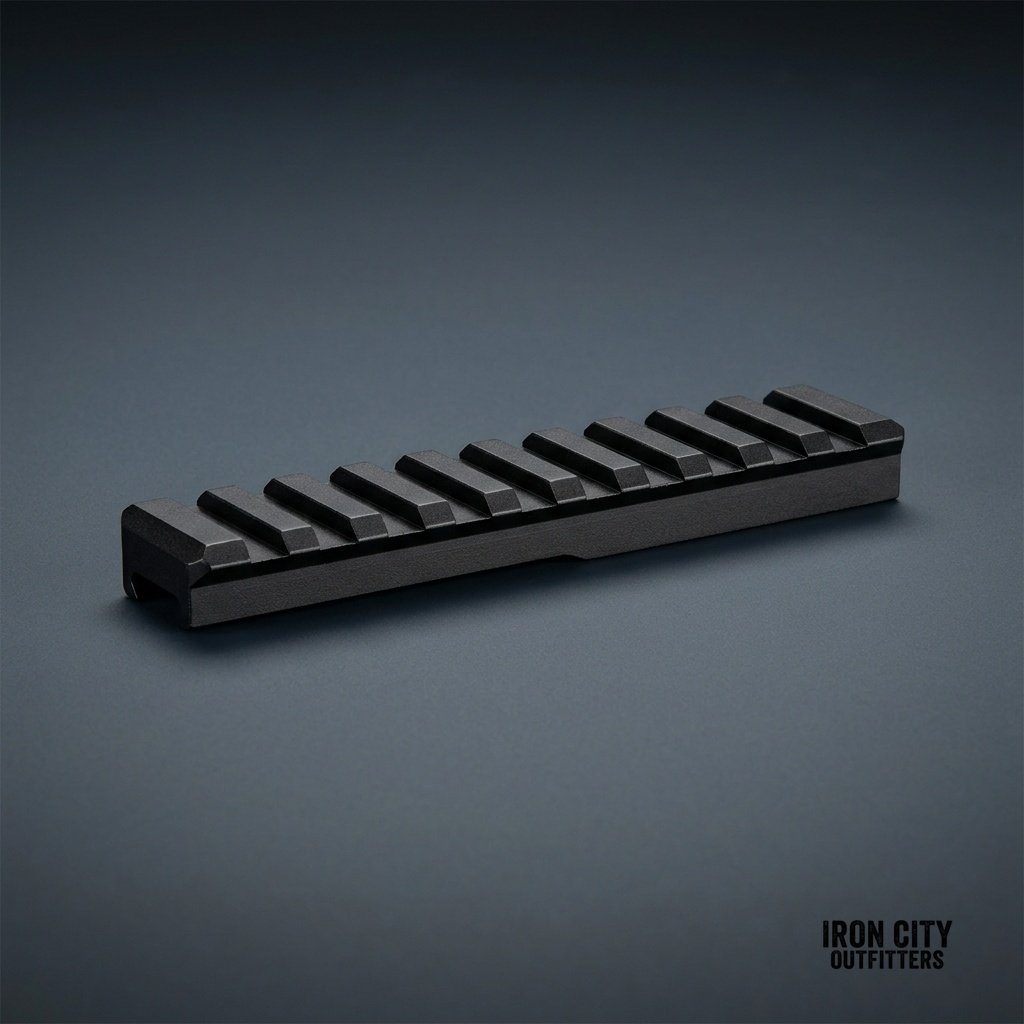
At 900 yards, a maxed-out elevation turret turns a five-figure rifle build into an expensive way to miss — and the failure point is rarely the glass. It’s the flat piece of aluminum bolted between receiver and scope.
The Warne Rail Mtn Savage LA 20MOA 8-40 exists to solve exactly that problem on long-action Savage platforms. Machined from 7075-T6 aircraft-grade aluminum, the rail carries a built-in 20-minute-of-angle incline — roughly 5.8 inches of forward cant over 100 yards — that shifts a scope’s usable elevation range downrange before a single click gets dialed. On a flat base, internal scope adjustment gets consumed compensating for bullet drop at extended distance, often running out well short of impact. A 20 MOA rail reclaims that travel, leaving headroom for wind calls, altitude corrections, and the kind of precision that separates a hit from a miss that’s hard to explain afterward.
Geometry alone does not hold zero under recoil; fitment does. The 8-40 screw pattern is machined to the exact bolt spacing of Savage long-action receivers, distributing recoil force evenly across the mounting points rather than concentrating stress on one or two screws. That precision fit is what keeps a base from shifting shot to shot — a loose or mismatched rail ranks among the most common, least diagnosed causes of a wandering zero.
The top surface follows MIL-STD-1913 (Picatinny) geometry and meets NATO STANAG 4694 spec, meaning cross-slot compatibility with the broad universe of rings, mounts, and quick-detach systems built to that standard rather than a proprietary rail demanding proprietary rings. Mil-spec hardcoat anodizing finishes the aluminum, adding surface hardness against scratching and a layer of corrosion resistance suited to rain, mud, and the handling a hunting or precision rig takes in the field across multiple seasons.
None of this is glamorous. A base does not group tighter or tame recoil. What it does is remove itself as a variable — holding a scope’s zero exactly where it was dialed, adding the elevation budget long-range shooting actually spends, and fitting a Savage long action the way a mil-spec part is supposed to: without gaps, without flex, without a second thought once torqued down.
For a long-action Savage build headed toward extended engagement distances, the rail is not the upgrade that gets discussed at the range. It is the one that decides whether the rifle reaches that distance in the first place.
Assisted by AI; content may contain inaccuracies.