
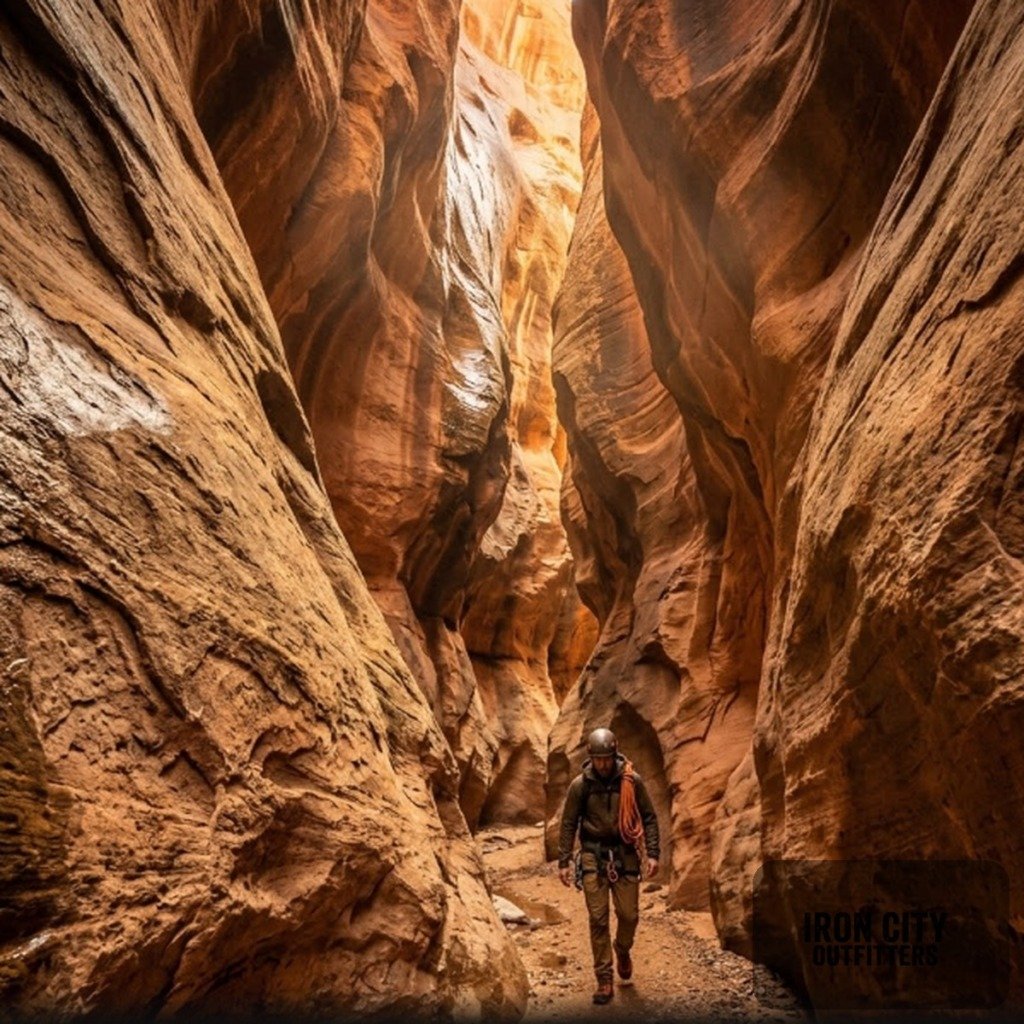
Sandstone walls narrow to shoulder-width, then narrower still, funneling floodwater and hikers alike toward a single carved amphitheater where sunlight refracts off a pool the color of struck flint. This is Neon Canyon, a tributary slot cut into the Escalante River drainage within Grand Staircase-Escalante National Monument, and its terminus, the Golden Cathedral, ranks among the most technically demanding, visually staggering endpoints in American canyoneering.
Access begins at the Egypt Trailhead off Hole-in-the-Rock Road, a washboarded dirt track that turns to impassable mud after rain and strands vehicles without four-wheel drive. From the trailhead, a cross-country descent of roughly 1,500 vertical feet drops through slickrock benches and sand dunes before reaching the Escalante River itself, where multiple unbridged crossings, thigh-deep during spring runoff and ankle-deep by late summer, must be forded to reach the mouth of Neon Canyon.
The canyon’s upper reaches present a graduated obstacle course of downclimbs, chokestones, and at least one mandatory rappel exceeding 100 feet, dropping directly into a submerged pool inside the Cathedral chamber itself. Wetsuits or drysuits count as standard equipment even in summer; water temperatures inside the alcove rarely exceed the mid-50s regardless of surface heat, and hypothermia risk compounds quickly for parties without proper thermal protection. Rope retrieval systems, canyon-specific harnesses, and redundant anchors remain non-negotiable. This terrain tolerates no improvisation.
Three skylights punched through the Navajo sandstone ceiling illuminate the Cathedral’s interior pool at specific hours, casting shafts of light that ignite suspended sediment into glowing columns. That window runs narrow and weather-dependent; overcast skies or a high midday sun angle can flatten the effect entirely, and flash flood potential from storms building miles away, invisible from within the canyon, can transform the chamber into a lethal trap within minutes. NOAA weather checks and ranger consultation at the Escalante Interagency Visitor Center rank as mandatory before descent, never optional.
Exit requires either climbing back out through the technical sections with hauled gear, or, for parties equipped for it, continuing downstream through the Escalante River corridor toward a secondary trailhead, a route decision made before entering the canyon, never during. Round-trip time from the Egypt Trailhead typically runs eight to twelve hours for technically proficient parties, and overnight permits are required for any extended traverse.
Assisted by AI; content may contain inaccuracies.