
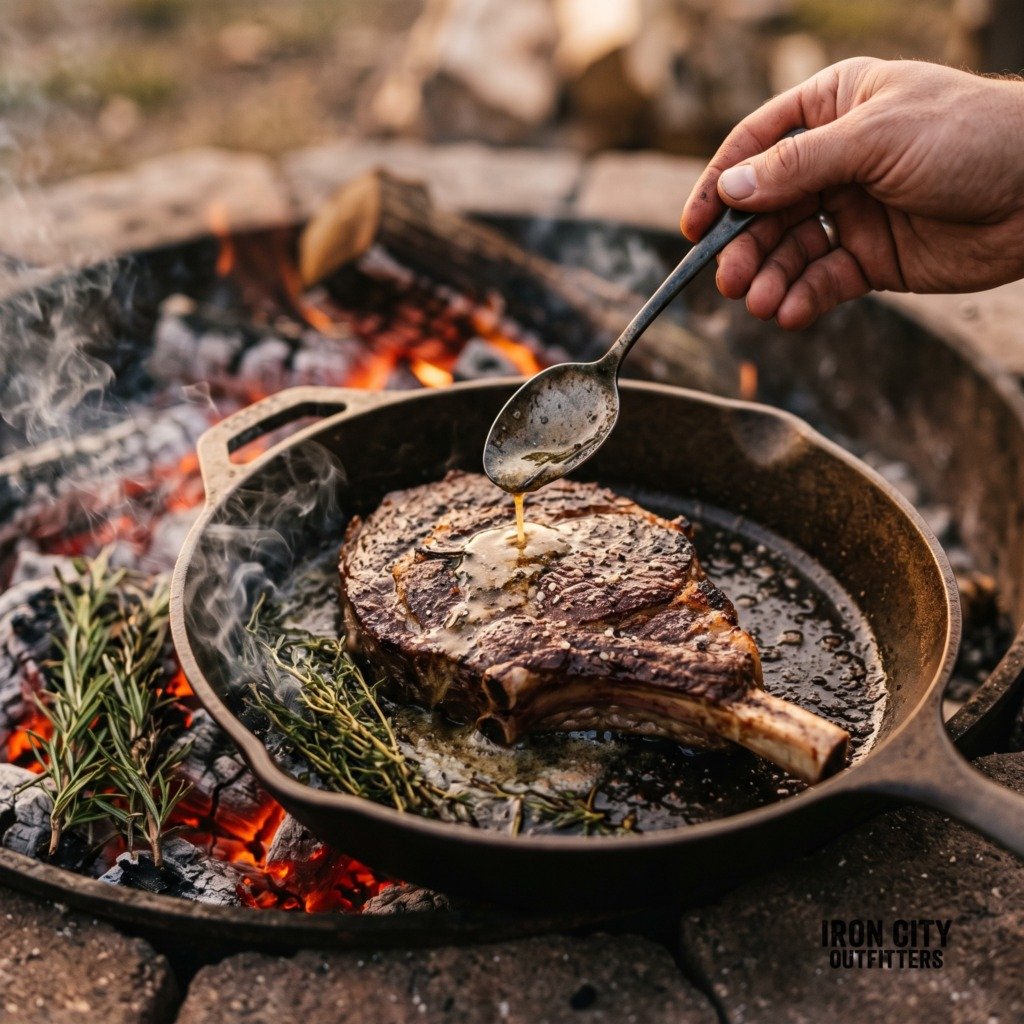
A sous vide immersion circulator holds a water bath within a tenth of a degree. A digital probe reports core temperature to the decimal point. None of that clinical precision survives contact with a bed of white-hot hardwood coals and four pounds of blued cast iron radiating heat unevenly across its face. Open-air cookery abandons the console for the coal bed, trading control for combustion — and the trade delivers a crust no enclosed oven, no matter how expensive, can replicate.
Cast iron over hardwood coals works on a principle the kitchen range cannot touch: mass. A seasoned skillet, once it soaks heat from a raked bed of oak or hickory embers, becomes a thermal reservoir far denser than any burner grate. Drop a bone-in ribeye onto that surface and the exterior proteins seize instantly, locking in a Maillard crust that deepens by the second while the interior stays untouched by the violence happening a quarter-inch above it. Precision cooking chases a target number. Fire cooking chases a color, a smell, a sound — the hiss dropping in pitch as the char sets.
Hardwood selection decides everything before the meat ever touches iron. Oak and hickory burn dense and slow, collapsing into coals that hold radiant heat for the full arc of a sear. Softwoods spike and vanish, leaving inconsistent char and resinous smoke that has no business near a ribeye. Ratio matters as much as species — too much wood floods the skillet with flame instead of radiant heat; too little starves the sear before the crust sets.
The finishing move separates a good sear from a memorable one: charred herb tallow, rendered from the ribeye’s own fat cap and infused with rosemary and thyme thrown directly onto the coals moments before basting. Smoke clings to the fat. Fat clings to the crust. The result reads as something closer to alchemy than cooking.
[Click Here to Copy the Full Recipe & Firewood Ratios]
Rushed technique produces gray, steamed meat with none of the smoke penetration that makes fire cooking worth the smoke in the eyes and the two-hour coal-building process. Patience with the coal bed is non-negotiable — a skillet dropped onto flame instead of settled coals scorches the exterior before the interior has any chance to catch up.
Full Recipe: Bone-In Ribeye Seared in Charred Herb Tallow
Firewood & Char Ratios
- Primary fuel: oak or hickory splits, roughly 3 lbs per skillet session
- Burn-down ratio: 45 minutes of open flame to collapse into coals before cooking begins
- Bed depth: 2–3 inches of glowing coal, raked flat under the skillet’s footprint
- Heat check: a hand held 6 inches above the bed should tolerate 3–4 seconds, no more
- Avoid: pine, cedar, or any resinous softwood — inconsistent heat, bitter smoke
Ingredients
- 1 bone-in ribeye, 1.5–2 inches thick, brought to ambient temperature
- Coarse sea salt and cracked black pepper
- 3 tbsp rendered beef tallow (reserved from the ribeye’s fat cap or store-bought)
- 2 sprigs fresh rosemary
- 2 sprigs fresh thyme
- 2 cloves garlic, crushed
Method
- Build the fire at least 45 minutes before cooking; burn hardwood down to a bed of consistent, glowing coals.
- Rake coals into an even layer and set the cast-iron skillet directly on top; allow 8–10 minutes of preheat until a drop of water skitters and vanishes on contact.
- Season the ribeye generously on both sides immediately before searing — salt applied too early draws moisture that resists a clean crust.
- Lay the ribeye into the dry skillet; press once to ensure full contact, then leave undisturbed for 3–4 minutes per side.
- During the final minute, add tallow, garlic, rosemary, and thyme to the skillet; toss a spare rosemary sprig directly onto the coals for aromatic smoke.
- Tilt the skillet and continuously spoon the melted, smoke-infused tallow over the crust for 60–90 seconds.
- Pull the ribeye at an internal temperature of 125–130°F for medium-rare; rest 8 minutes under loose foil before slicing against the grain.
Assisted by AI; content may contain inaccuracies.